



What is Khatauni and Khasra in Bhulekh? Meaning, Difference, and How to Download



Khatauni and Khasra are the core land record documents used in rural India, maintained by each state’s Revenue Department. Khasra is the unique number assigned to a specific plot in village revenue records, while Khatauni lists the plot’s owners, area, and land details under one khata (ownership account).
Land ownership in India depends on official records that identify each plot and the person whose name appears against it. Knowing what is Khatauni and Khasra helps buyers review these details before any property transaction.
These documents show plot particulars and ownership entries. This article explains their purpose, key differences, and the steps required to download them from the UP Bhulekh portal.
Table of Contents
What is Khasra? The Plot-Level Land Record Explained
Khasra is a revenue document that assigns a unique identification number to a specific plot in a village or rural area. It records the plot’s area, ownership, soil type, and usage, and is maintained by the village patwari as part of the state land revenue system. Every buyer purchasing agricultural or a plot on the city outskirts, the Khasra number is the first thing you will be asked for – it is what links the actual plot on the ground to its entry in the government’s land records.
What a Khasra Number Contains: Area, Boundaries, Soil & Crop Entries
Khasra entry may include:
- Plot details: Area, boundaries, and location
- Individual details: Name of the owner or cultivator
- Usage Use: Shows soil type and crops grown
- Area Size: Indicates total physical measurement
Which States Allocate Khasra Number?
Uttar Pradesh, Bihar, Jharkhand, Madhya Pradesh, Uttarakhand, Himachal Pradesh, Haryana, and Punjab allocate these numbers within their systems.
What is Khatauni? The Owner-Level Record of Landholdings.
Khatauni is an official revenue document that functions as a Record of Rights (RoR). It names the individual or cultivator, and links every plot held under the account. This explains what is Khatauni and Khasra within village administration.
What a Khatauni Contains: Khatedaars, Shares, and Linked Khasra Entries
This legal record may show:
- Khatedaar details: Name of the owner or co-owner
- Ownership share: Portion assigned to each person
- Account reference: Unique Khatauni number
- Linked plots: Relevant Khasra nos.
- Total area: Measurement in the applicable unit
- Usage: Classification assigned to the parcel
Khatauni, Khewat, and Khata Number: How the 3 Accounts Differ
Khata, Khasra, Khatauni terminology varies by state revenue system, so each term should be read in its specific administrative context.
Khewat traces the ownership sequence and records the share of groups / families in the village estate before individual plots are carved out. Khewat number identifies the ownership account in the Jamabandi (village Record of Rights register).
Khata number refers to the account linked to possession or cultivation.
Khatauni is the register that lists the plots connected with that account, along with the relevant Khasra references.

Difference between Khasra and Khatauni at a Glance
These entries serve distinct purposes. One identifies an individual plot, while the other connects multiple plots to the person.
| Feature | Khasra | Khatauni |
| What it identifies | A specific single plot or field parcel |
All plots associated with an individual or family under one account
|
| Also called | Plot register, field book, or Khasra Girdawari | Account-level record of rights (RoR) / holding statement |
| Core contents | Plot number (Gata / survey no.), exact area, boundaries, soil type, crops grown | Owner name, share proportions, total area, linked Khasra no. |
| Unit of record | Single physical plot or parcel | Individual or cultivator account unit |
| Form / register | Form P-II (12 columns) | Form B-I (23 columns) |
| Derived from | Physical village maps (Shajra) and ground surveys | Compiled from Khasra changes and mutation orders |
| Updated when | Seasonally (for crop changes), or upon subdivision | Annually or after an approved mutation (Dakhil Kharij) |
| Buyer uses it to check | Plot boundaries and physical size | Legal title ownership, share split, and clear seller rights |
How Khasra Khatauni Connects to Bhulekh, Bhu Naksha, Shajra, and Jamabandi
The two documents link written revenue entries with village maps and ownership accounts.
Bhulekh is the UP state website that displays these entries.
Shajra is the hand-drawn village map, while Bhu Naksha is its computerised version. Each Khasra no. corresponds to a marked land parcel on either map.
Jamabandi is the Record of Rights that compiles ownership shares and mutation history. On UP Bhulekh Khatauni, users can search the account and review linked plots.
Who Prepares and Updates Khasra Khatauni Land Record Documents
These entries are maintained by the revenue department and updated whenever ownership, cultivation, or survey particulars change. The process follows prescribed verification and mutation procedures.
Role of Lekhpal, Patwari, and Tehsildar in the Revenue Department
Patwari or Lekhpal measures plots, notes cultivation details, and assigns plot references using the Shajra. Kanungo examines entries and verifies field particulars. Tehsildar reviews mutation applications and approves changes arising from sale or inheritance.
How Often Land Records India Entries Are Revised
Revision periods differ by state. In UP, Khatauni is updated continuously when a mutation order is passed by the Tehsildar, while Khasra is modified during periodic crop inspections (Patal) and major survey operations.
Haryana, Punjab, and Himachal Pradesh generally undertake a fresh Jamabandi cycle every 4-5 years. Approved mutations may update the register between these cycles.
Importance of Khatauni and Khasra in Property Transactions
Knowing what is Khatauni and Khasra complements a detailed title review before signing the sale deed. These entries reveal ownership and legal restrictions linked to the land parcel.
- Confirming the Seller is the Recorded Khatedaar: Match the name with the Khatauni entry
- Reading Mutation Entries to Spot an Incomplete Ownership Transfer: Review whether the previous transfer has received mutation approval
- Checking Mortgage, Charge, and Bank Lien Entries: Identify financial claims recorded against the holding
- Identifying Stay Orders, Partition Suits, and Revenue Court Disputes: Examine remarks concerning pending proceedings or transfer restraints
- Verifying Land Classification and Whether the Parcel is Transferable: Confirm the permitted category before property registration in Noida and Greater Noida.
For a broader due diligence framework, the legal checklist before buying property in Greater Noida provides additional guidance on ownership papers, approvals, and statutory verification.
How to Download Khasra Khatauni Online from the UP Bhulekh Portal
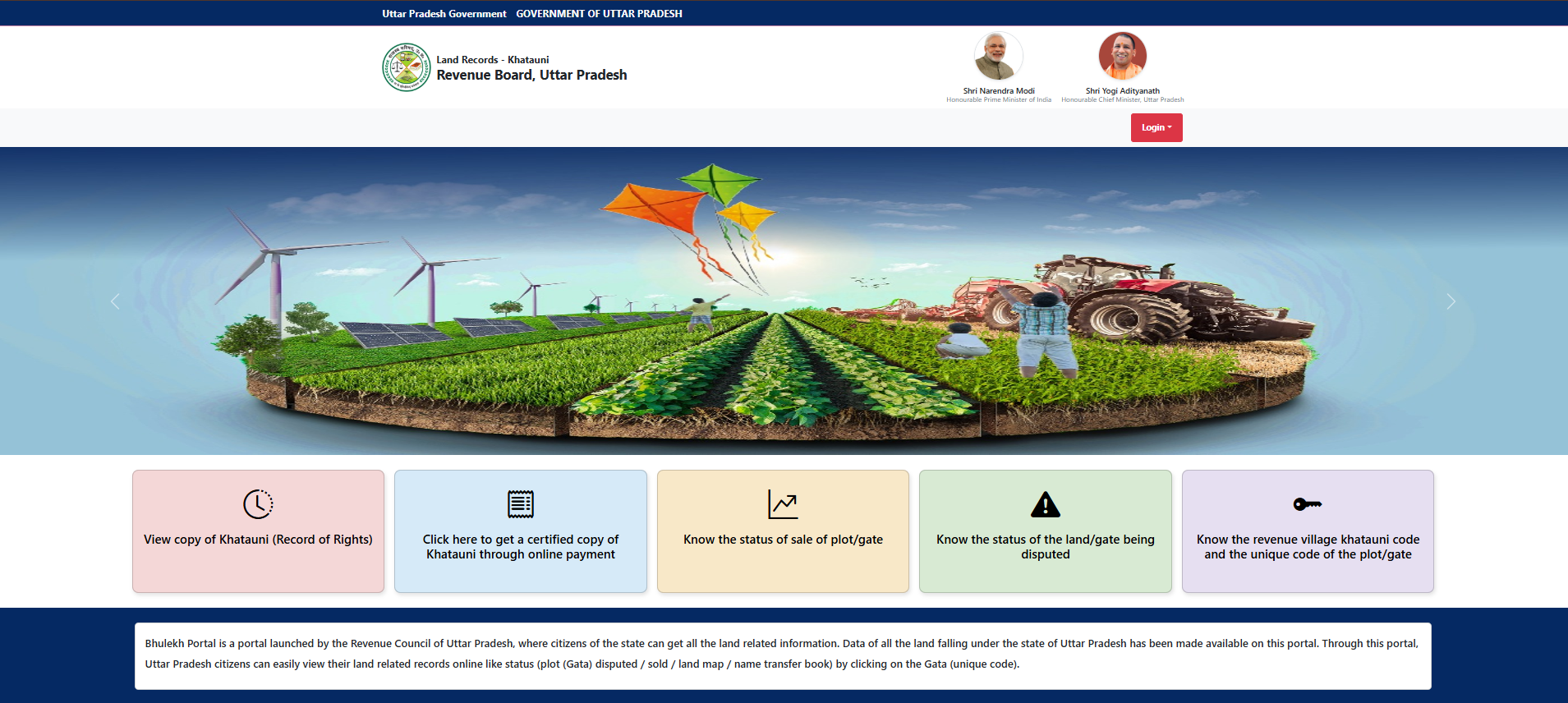
Khasra Khatauni download is facilitated by the website managed by the Board of Revenue, Uttar Pradesh. The Khatauni download shown on screen can be saved or printed for reference.
Step 1: Open the Official Bhulekh Portal and Select District, Tehsil, Village
Go to the official website and click ‘View Khatauni’ / ‘Record of Rights’. Enter the captcha code shown on the screen. Select the relevant District, Tehsil, and Village from the dropdown lists.
Step 2: Search by Gata Number, Khata Number, Khatedaar Name, or Registration Number
Choose the relevant search option. Enter the Khasra or Gata number, Khatauni number, or owner’s name. Select the matching result from the entries displayed.
Step 3: Enter the Captcha and Open the Khatauni Record on Screen
Complete the verification code to display the account particulars.
Step 4: Download or Print the Khasra Khatauni Copy
Viewing, saving, or printing an informational online copy of Khasra and Khatauni records from the official UP Bhulekh website is free of cost. For a certified physical copy bearing the authorised signature and seal, the fee is generally around ₹15 to ₹30 per page.
Step 5: Request a Certified Khatauni Nakal, when a Legally Admissible Copy is Needed
Choose the ‘certified copy’ option and complete the prescribed payment. The authorised computerised extract carries legal validity as a verified Record of Rights.
How to Check Khasra Number and Khatauni Details Online
The UP revenue website explains how to check Khasra number online through plot references or account particulars. Follow these 7 steps:
- Visit the official land records website at https://upbhulekh.gov.in/
- Select the district, tehsil, and village
- Choose a search option: Khasra and Khatauni no., or individual’s name
- Enter the relevant reference in the search field
- Complete the captcha verification, where required
- Select the matching result to view the revenue extract
- Save the displayed page as a PDF or print a copy for reference
Common Errors in Khasra Khatauni Records and How to Get Them Corrected
Understanding what is Khatauni and Khasra also involves checking whether each entry matches the supporting papers. Those reviewing luxury flats in Greater Noida can cross-reference historical details to trace the pre-acquisition chain of custody, or the sequence of prior transfers linked to the site.
| Common error | How to get it corrected |
| Incorrect name | Submit an application with identity proof and relevant sale deed to the Tehsil office |
| Wrong plot area | Request field verification through the Lekhpal and attach the village map extract |
| Missing mutation | File the mutation request with the transfer papers and applicable fee receipt |
| Mismatched Khasra no. |
Request rectification from the Tehsildar with the registered papers and prior revenue entries
|
Once the corrected entries appear in the system, the parties can proceed with the sale deed and applicable stamp duty and registration charges in Noida and Greater Noida.
Khasra Khatauni for Apartment Buyers: What Applies to a Flat in Greater Noida or Gurgaon
Homebuyers do not receive a separate Khasra or Khatauni entry for each flat, since these particulars relate to the parent parcel associated with the project.
For older sites, title verification may involve matching historical Khasra details with the mother deed, to trace the pre-acquisition chain of custody. While examining flats in Noida Extension, this cross-reference can help establish how rights over the site changed hands before land acquisition for the current project.
For flats for sale in Greater Noida, trace the cited Khasra details to the approved project land. In Gurgaon, examine the title chain and licence papers linked to the site.
Khasra Khatauni and the Move to ULPIN: What is Changing in Land Records India
These documents remain central to village administration, while ULPIN introduces a geo-referenced identity for each plot. Also called Bhu-Aadhaar, this 14-digit alphanumeric code uses the coordinates of parcel boundary points.
ULPIN links textual entries with Bhu Naksha data under the Digital India Land Records Modernisation Program. It can help identify duplicate plot references and boundary inconsistencies. During property registration, the code can support precise matching between the identified parcel and its mapped location.
FAQs
Is Khatauni proof of ownership of land?
Yes, Khatauni is a proof of ownership of land for revenue purposes, showing the khatedaar, linked plots, and their share.
Can a Khasra no. change over time?
A Khasra no. can change due to subdivision, consolidation, land use conversion etc.
What is a Gata number in Uttar Pradesh land records?
Gata number in Uttar Pradesh is a unique plot or survey reference, commonly used in the same context as Khasra no.
How long does mutation take to reflect in the Khatauni?
Mutation may take 15-30 days to reflect in the Khatauni, subject to verification, objections, and completion of formalities.
Is a Khatauni downloaded online accepted by banks for a loan?
A Khatauni downloaded online may be accepted by banks for preliminary verification, though final loan sanction may require a certified or digitally signed copy from the revenue authority or state portal.
What should I do if the Khasra no. on my sale deed does not match the record?
A mismatch between the Khasra no. on the sale deed and the record should be taken to the Tehsildar with the registered papers, prior entries, and supporting map extract for rectification.
Is there any fee to download Khasra and Khatauni online?
Khasra and Khatauni copy viewed or saved from the state portal is generally available for free, while a certified Nakal may cost ₹15-30 per page.
Can NRIs check Khasra and Khatauni records from outside India?
Yes, NRIs can view these from outside India, on the UP Bhulekh portal: https://upbhulekh.gov.in/
You might also like


